


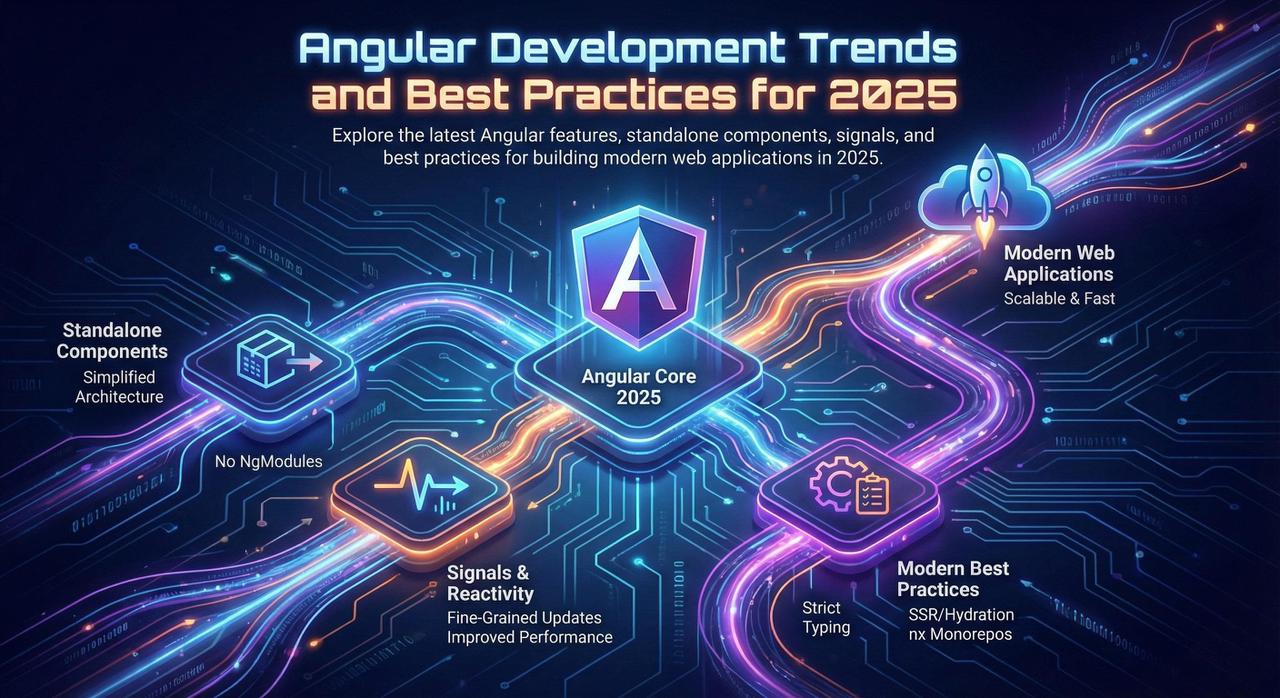
Angular continues to evolve as one of the most powerful frameworks for building enterprise-grade web applications. In 2025, Angular brings exciting new features that make development faster, more efficient, and more enjoyable than ever before.
The Evolution of Angular in 2025
Angular has come a long way since its inception. The framework has matured significantly, with Google continuously investing in making it more developer-friendly while maintaining its enterprise-grade capabilities. The latest versions introduce groundbreaking features that simplify development without sacrificing performance.
Key Insight
According to the State of JS 2024 survey, Angular remains the top choice for enterprise applications, with 78% of Fortune 500 companies using it for their mission-critical applications. The framework's stability and long-term support make it ideal for large-scale projects.
Standalone Components Revolution
Angular's standalone components have matured significantly, eliminating the need for NgModules in most applications. This simplifies the mental model and reduces boilerplate code dramatically. You can now build entire applications without a single NgModule.
@Component({
selector: 'app-user-profile',
standalone: true,
imports: [CommonModule, RouterModule, FormsModule],
template: `
{{ user.name }}
{{ user.email }}
`
})
export class UserProfileComponent {
user = signal({ name: 'John Doe', email: 'john@example.com' });
editProfile() {
// Edit logic here
}
}Signals: The Future of Reactivity
Angular Signals provide a new way to handle reactive state management. Unlike RxJS observables, signals are simpler to understand and use, making your code more predictable and easier to debug.
Why Signals Matter
- Simpler Mental Model: No need to understand complex RxJS operators for basic state management
- Better Performance: Fine-grained reactivity means only affected components re-render
- Easier Debugging: Synchronous updates make it easier to trace state changes
- TypeScript Integration: Full type inference without manual type annotations
// Creating and using signals
const count = signal(0);
const doubleCount = computed(() => count() * 2);

// Updating signals
count.set(5);
count.update(value => value + 1);

// Effects for side effects
effect(() => {
  console.log('Count changed:', count());
  // This runs whenever count changes
});
Improved Server-Side Rendering (SSR)
Angular Universal has been enhanced with better hydration support, making SSR applications faster and more SEO-friendly. The new hydration mechanism preserves DOM nodes created during server rendering, reducing time to interactive significantly.
Faster TTI
Time to Interactive reduced by up to 45% with the new hydration mechanism. Users can interact with the page faster.
Better SEO
Full server-side rendering ensures search engines can crawl and index your content effectively.
Best Practices for Angular Development in 2025
-
1
Use Standalone Components
Embrace the module-less architecture for cleaner, more maintainable code. Standalone components reduce complexity and improve tree-shaking.
-
2
Adopt Signals for State Management
Start migrating from RxJS to Signals for simpler state management. Use RxJS only for complex async operations like HTTP requests.
-
3
Implement Lazy Loading
Use route-level code splitting to reduce initial bundle size. Load features on-demand for better performance.
-
4
Enable Strict Mode
Use strict TypeScript checks for better code quality. Catch errors at compile time rather than runtime.
-
5
Use OnPush Change Detection
Optimize performance by using OnPush change detection strategy. This reduces unnecessary re-renders significantly.
Performance Optimization Tips
Bundle Optimization
Use the Angular CLI's built-in optimization features. Enable production mode, tree-shaking, and ahead-of-time compilation for smaller bundles.
Image Optimization
Use NgOptimizedImage directive for automatic image optimization. It handles lazy loading, responsive images, and modern formats.
Conclusion
Angular in 2025 is more powerful and developer-friendly than ever. By adopting these new features and best practices, you can build faster, more maintainable applications that scale with your business needs.
The framework's commitment to stability, combined with continuous innovation, makes it an excellent choice for enterprise applications. Whether you're starting a new project or modernizing an existing one, Angular provides the tools and patterns you need to succeed.
Start experimenting with standalone components and signals today, and you'll be well-prepared for the future of Angular development.