


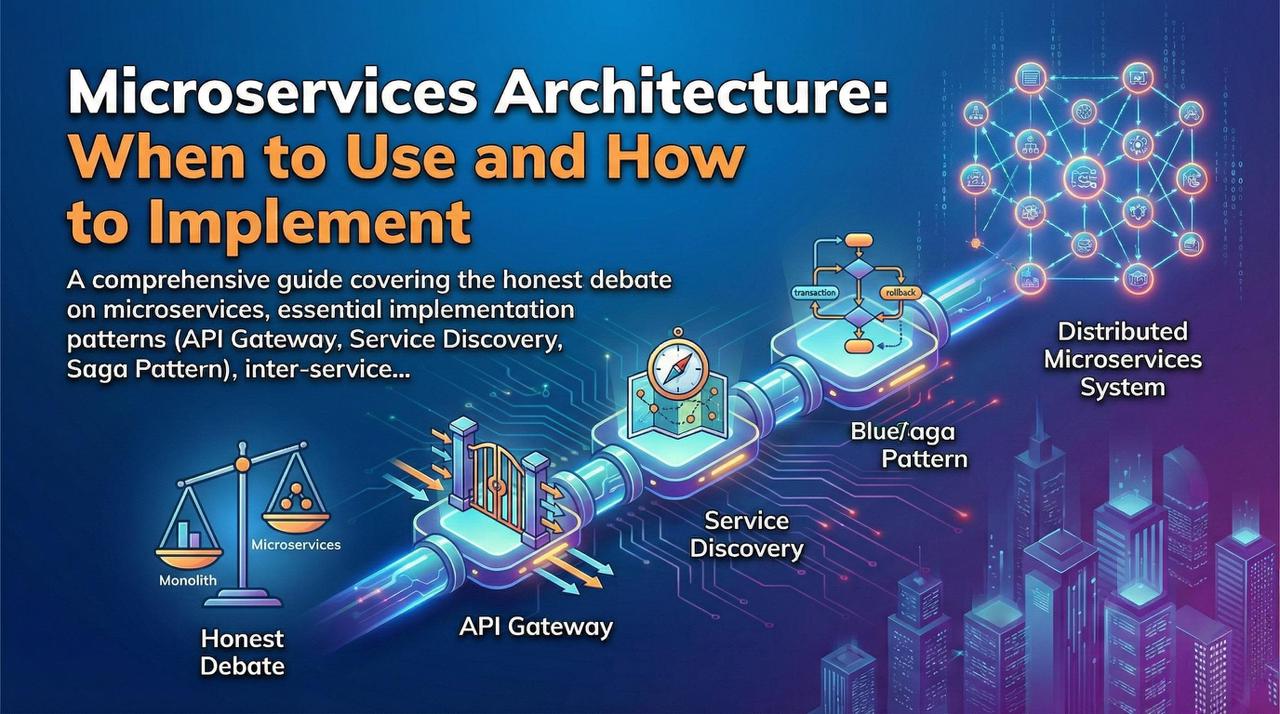
Microservices have become the default architectural choice for many organizations—often without critical evaluation of whether they're appropriate. This guide provides an honest assessment of when microservices make sense, when they don't, and the essential patterns you need to implement them successfully. We'll cut through the hype and focus on practical, battle-tested approaches.
The Honest Debate: Microservices Aren't Always Better
Let's start with an uncomfortable truth: microservices are not inherently superior to monoliths. They're a trade-off, exchanging one set of problems for another. The "complexity tax" of distributed systems is real and substantial.
The Complexity Tax of Distributed Systems
When you decompose a monolith into microservices, you gain certain benefits but inherit significant complexity:
- Independent deployment of services
- Technology diversity (polyglot)
- Isolated scaling of components
- Team autonomy and ownership
- Fault isolation (one service failure doesn't crash everything)
- Network latency and reliability issues
- Distributed transactions and data consistency
- Service discovery and load balancing
- Distributed tracing and debugging
- Operational complexity (N services — M environments)
- Testing complexity (integration, contract, E2E)
The Distributed Monolith Anti-Pattern
The worst outcome is a "distributed monolith"—services that are technically separate but tightly coupled, requiring coordinated deployments. You get all the complexity of microservices with none of the benefits. This happens when service boundaries are drawn incorrectly or when teams don't embrace true service independence.
When to Use vs. When to Avoid Microservices
Use Microservices When:
- Large teams (50+ developers): Multiple teams need to work independently without stepping on each other
- Different scaling requirements: Some components need 100x the resources of others
- Different technology needs: ML models in Python, real-time in Go, CRUD in Node.js
- Clear domain boundaries: Your business has distinct, well-understood domains (orders, inventory, payments)
- High availability requirements: You need fault isolation—one component's failure shouldn't cascade
- Frequent, independent releases: Different parts of the system evolve at different rates
Avoid Microservices When:
- Small team (< 10 developers): The operational overhead will consume your capacity
- Simple CRUD applications: A well-structured monolith is simpler and faster to develop
- Unclear domain boundaries: If you don't understand your domain, you'll draw wrong boundaries
- Startup/MVP phase: You need to iterate quickly; microservices slow you down
- Tight coupling is inherent: If services must always be deployed together, they shouldn't be separate
- Limited DevOps maturity: Without CI/CD, monitoring, and container orchestration, microservices are painful
Essential Implementation Patterns
Pattern 1: API Gateway
An API Gateway provides a single entry point for all client requests, handling cross-cutting concerns like authentication, rate limiting, and request routing.
                        █Œ─────────────────────────────────────┐
                        │              Clients                 │
                        │   (Web, Mobile, Third-party APIs)    │
                        └─────────────────█¬───────────────────█˜
                                          │
                                          ۬
                        █Œ─────────────────────────────────────┐
                        │            API Gateway               │
                        │  █Œ─────────────────────────────────┐│
                        │  │ • Authentication/Authorization  ││
                        │  │ • Rate Limiting                 ││
                        │  │ • Request/Response Transform    ││
                        │  │ • Load Balancing                ││
                        │  │ • Circuit Breaking              ││
                        │  │ • Logging/Monitoring            ││
                        │  └─────────────────────────────────█˜│
                        └─────────────────█¬───────────────────█˜
                                          │
              █Œ───────────────────────────█¼───────────────────────────┐
              │                           │                           │
              ۬                           ۬                           ۬
    █Œ─────────────────┐       █Œ─────────────────┐       █Œ─────────────────┐
    │  User Service   │       │  Order Service  │       │ Product Service │
    └─────────────────█˜       └─────────────────█˜       └─────────────────█˜
Popular API Gateway Solutions:
- Kong: Open-source, plugin-based, excellent for Kubernetes
- AWS API Gateway: Fully managed, integrates with Lambda and other AWS services
- Nginx/Envoy: High-performance, often used with service mesh
- Traefik: Cloud-native, automatic service discovery
Pattern 2: Service Discovery
In a dynamic environment where services scale up/down and IP addresses change, services need a way to find each other. Service discovery solves this.
Client-Side Discovery:
█Œ─────────────┐    1. Query    █Œ─────────────────┐
│   Service   │───────────────█¶│ Service Registry│
│      A      │                │   (Consul/etcd) │
└──────█¬──────█˜                └────────█¬────────█˜
       │                                │
       │ 2. Get service B locations     │
       │█€───────────────────────────────█˜
       │    [B: 10.0.1.5:8080,
       │        10.0.1.6:8080]
       │
       │ 3. Direct call (with load balancing)
       ۬
█Œ─────────────┐
│   Service   │
│      B      │
└─────────────█˜

Server-Side Discovery (via Load Balancer):
█Œ─────────────┐    1. Call    █Œ─────────────────┐    2. Route    █Œ─────────────┐
│   Service   │──────────────█¶│  Load Balancer  │───────────────█¶│   Service   │
│      A      │               │  (knows B's IPs)│                │      B      │
└─────────────█˜               └─────────────────█˜                └─────────────█˜
Service Discovery Solutions:
- Kubernetes DNS: Built-in service discovery via DNS names (service.namespace.svc.cluster.local)
- Consul: Feature-rich, supports health checking, KV store, and multi-datacenter
- etcd: Distributed key-value store, used by Kubernetes itself
- AWS Cloud Map: Managed service discovery for AWS workloads
Pattern 3: Inter-Service Communication
How services communicate is one of the most critical architectural decisions. The choice between synchronous and asynchronous communication has profound implications.
Synchronous Communication (REST/gRPC)
| Aspect | REST | gRPC |
|---|---|---|
| Protocol | HTTP/1.1 or HTTP/2 | HTTP/2 (required) |
| Payload | JSON (text) | Protocol Buffers (binary) |
| Performance | Good | Excellent (10x faster serialization) |
| Streaming | Limited | Bidirectional streaming |
| Browser Support | Native | Requires gRPC-Web |
| Best For | Public APIs, simple CRUD | Internal services, high-throughput |
Asynchronous Communication (Message Brokers)
Asynchronous communication decouples services in time—the sender doesn't wait for a response. This improves resilience and scalability but adds complexity.
█Œ─────────────┐                                      █Œ─────────────┐
│   Order     │    1. Publish                        │  Inventory  │
│   Service   │───────────────┐                      │   Service   │
└─────────────█˜               │                      └──────█²──────█˜
                              │                             │
                              █¼                             │ 3. Consume
                    █Œ─────────────────┐                     │
                    │  Message Broker │─────────────────────█˜
                    │  (Kafka/RabbitMQ)│
                    └────────█¬────────█˜
                             │
                             │ 3. Consume
                             ۬
                    █Œ─────────────────┐
                    │   Notification  │
                    │     Service     │
                    └─────────────────█˜

Event: OrderCreated
{
  "eventId": "evt-123",
  "eventType": "OrderCreated",
  "timestamp": "2025-11-08T10:30:00Z",
  "data": {
    "orderId": "ord-456",
    "customerId": "cust-789",
    "items": [...],
    "total": 299.99
  }
}
Message Broker Comparison:
- Apache Kafka: High-throughput, persistent log, excellent for event sourcing. Best for: high-volume event streaming, audit logs, real-time analytics.
- RabbitMQ: Traditional message broker, flexible routing, supports multiple protocols. Best for: task queues, RPC patterns, complex routing.
- AWS SQS/SNS: Fully managed, simple to use, integrates with AWS ecosystem. Best for: AWS-native applications, simple pub/sub.
Sync vs Async Trade-offs
Synchronous: Simpler to implement, easier to debug, but creates tight coupling and cascading failures. Asynchronous: Better resilience and scalability, but harder to debug, requires idempotency, and introduces eventual consistency challenges. Most systems use a mix of both.
Pattern 4: Database per Service
Each microservice should own its data. This is perhaps the most challenging aspect of microservices—and the most frequently violated.
WRONG: Shared Database (Distributed Monolith)
█Œ─────────────┐     █Œ─────────────┐     █Œ─────────────┐
│   Service   │     │   Service   │     │   Service   │
│      A      │     │      B      │     │      C      │
└──────█¬──────█˜     └──────█¬──────█˜     └──────█¬──────█˜
       │                   │                   │
       └───────────────────█¼───────────────────█˜
                           │
                           ۬
                  █Œ─────────────────┐
                  │ Shared Database │  █€── Tight coupling!
                  └─────────────────█˜

RIGHT: Database per Service
█Œ─────────────┐     █Œ─────────────┐     █Œ─────────────┐
│   Service   │     │   Service   │     │   Service   │
│      A      │     │      B      │     │      C      │
└──────█¬──────█˜     └──────█¬──────█˜     └──────█¬──────█˜
       │                   │                   │
       ۬                   ۬                   ۬
█Œ─────────────┐     █Œ─────────────┐     █Œ─────────────┐
│ Database A  │     │ Database B  │     │ Database C  │
│ (PostgreSQL)│     │  (MongoDB)  │     │   (Redis)   │
└─────────────█˜     └─────────────█˜     └─────────────█˜
The Saga Pattern for Distributed Transactions
When a business transaction spans multiple services, you can't use traditional ACID transactions. The Saga pattern manages distributed transactions through a sequence of local transactions with compensating actions for rollback.
Choreography-based Saga (Event-driven):

1. Order Service: Create Order (PENDING)
   └──█¶ Publish: OrderCreated

2. Payment Service: Process Payment
   └──█¶ Publish: PaymentProcessed OR PaymentFailed

3. Inventory Service: Reserve Items
   └──█¶ Publish: ItemsReserved OR ItemsUnavailable

4. Shipping Service: Schedule Delivery
   └──█¶ Publish: DeliveryScheduled

5. Order Service: Update Order (CONFIRMED)

Compensation (if Payment fails):
- Order Service: Cancel Order
- Inventory Service: Release Reserved Items
- Notification Service: Send Cancellation Email

Orchestration-based Saga (Central Coordinator):
█Œ─────────────────────────────────────────────────────────┐
│                   Saga Orchestrator                      │
│  █Œ─────────────────────────────────────────────────────┐│
│  │ Step 1: CreateOrder()                               ││
│  │ Step 2: ProcessPayment()                            ││
│  │ Step 3: ReserveInventory()                          ││
│  │ Step 4: ScheduleDelivery()                          ││
│  │ Step 5: ConfirmOrder()                              ││
│  │                                                     ││
│  │ Compensations:                                      ││
│  │ - CancelOrder()                                     ││
│  │ - RefundPayment()                                   ││
│  │ - ReleaseInventory()                                ││
│  └─────────────────────────────────────────────────────█˜│
└─────────────────────────────────────────────────────────█˜
The Role of Docker and Kubernetes
Docker: The Standard Unit of Deployment
Containers solve the "works on my machine" problem by packaging applications with their dependencies. Docker has become the de facto standard for containerization.
# Multi-stage build for smaller images
FROM node:20-alpine AS builder
WORKDIR /app
COPY package*.json ./
RUN npm ci --only=production
COPY . .
RUN npm run build

FROM node:20-alpine AS runtime
WORKDIR /app

# Security: Run as non-root user
RUN addgroup -g 1001 -S nodejs && \
    adduser -S nodejs -u 1001
USER nodejs

# Copy only production artifacts
COPY --from=builder --chown=nodejs:nodejs /app/dist ./dist
COPY --from=builder --chown=nodejs:nodejs /app/node_modules ./node_modules

# Health check
HEALTHCHECK --interval=30s --timeout=3s --start-period=5s --retries=3 \
  CMD wget --no-verbose --tries=1 --spider http://localhost:3000/health || exit 1

EXPOSE 3000
CMD ["node", "dist/main.js"]
Kubernetes: Orchestrating at Scale
Kubernetes solves the orchestration challenges inherent in microservices: deployment, scaling, service discovery, load balancing, and self-healing.
apiVersion: apps/v1
kind: Deployment
metadata:
  name: order-service
  labels:
    app: order-service
spec:
  replicas: 3
  selector:
    matchLabels:
      app: order-service
  template:
    metadata:
      labels:
        app: order-service
    spec:
      containers:
      - name: order-service
        image: myregistry/order-service:v1.2.3
        ports:
        - containerPort: 8080
        resources:
          requests:
            memory: "256Mi"
            cpu: "250m"
          limits:
            memory: "512Mi"
            cpu: "500m"
        livenessProbe:
          httpGet:
            path: /health/live
            port: 8080
          initialDelaySeconds: 10
          periodSeconds: 10
        readinessProbe:
          httpGet:
            path: /health/ready
            port: 8080
          initialDelaySeconds: 5
          periodSeconds: 5
        env:
        - name: DATABASE_URL
          valueFrom:
            secretKeyRef:
              name: order-service-secrets
              key: database-url
---
apiVersion: v1
kind: Service
metadata:
  name: order-service
spec:
  selector:
    app: order-service
  ports:
  - port: 80
    targetPort: 8080
  type: ClusterIP
Conclusion: Microservices Done Right
Microservices are a powerful architectural pattern—when applied appropriately. The key takeaways:
- Don't start with microservices: Begin with a well-structured monolith. Extract services when you have clear domain boundaries and team scaling needs.
- Embrace the complexity tax: If you're not prepared for distributed systems challenges, microservices will hurt more than help.
- Get the boundaries right: Wrong service boundaries create distributed monoliths. Use Domain-Driven Design to identify bounded contexts.
- Invest in platform capabilities: CI/CD, monitoring, service mesh, and container orchestration are prerequisites, not nice-to-haves.
- Choose communication patterns wisely: Use synchronous for queries, asynchronous for commands. Embrace eventual consistency.
- Own your data: Database per service is hard but essential. Use sagas for distributed transactions.
The goal isn't to have microservices—it's to have a system that enables your organization to deliver value quickly and reliably. Sometimes that's microservices. Sometimes it's a well-designed monolith. Choose based on your context, not industry trends.