

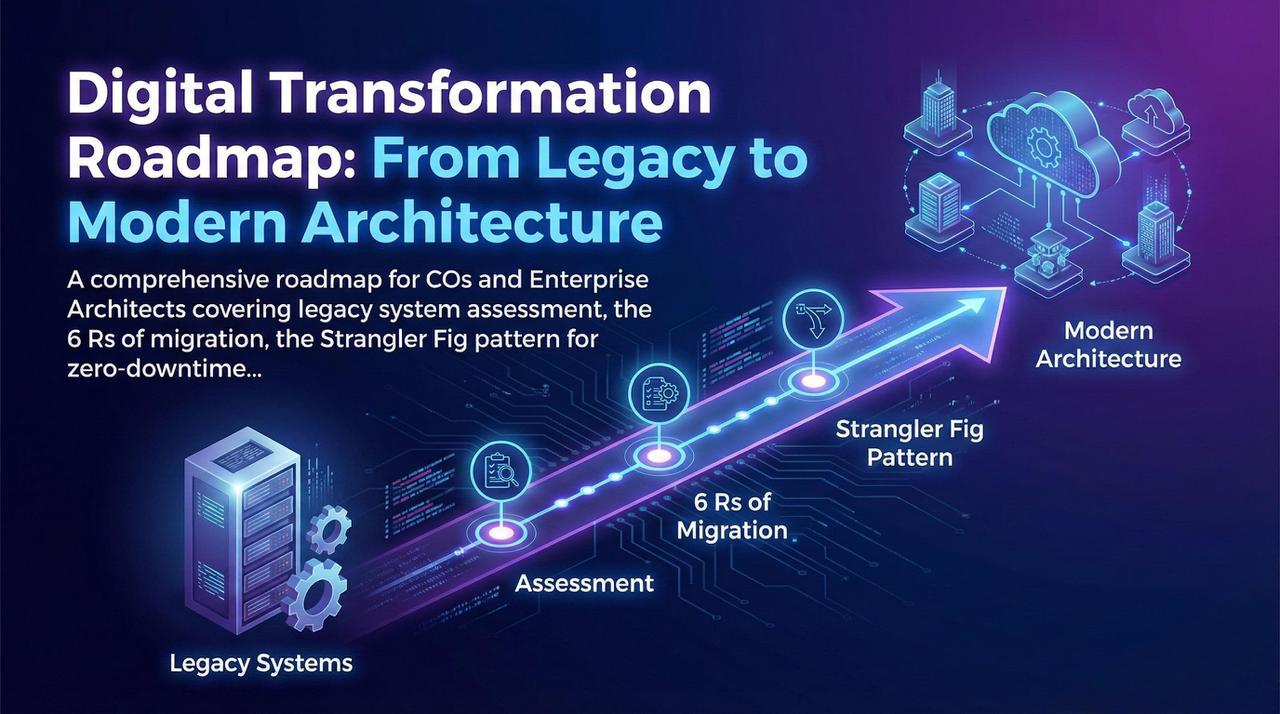
Digital transformation isn't a buzzword—it's an existential imperative. Organizations clinging to legacy systems face mounting technical debt, security vulnerabilities, talent attrition, and competitive disadvantage. Yet the path from legacy to modern architecture is fraught with risk: failed migrations have derailed careers and bankrupted companies. This guide provides a battle-tested roadmap for CTOs, Enterprise Architects, and IT Strategy Leaders who need to modernize without disrupting operations.
Defining the Legacy Problem: Why Modernization Is Non-Negotiable
Before diving into solutions, let's be clear-eyed about what we're dealing with. Legacy systems aren't just "old technology"—they represent accumulated technical debt that compounds over time.
The True Cost of Legacy Systems
- 70-80% of IT budgets consumed by maintenance
- Expensive specialized talent (COBOL developers command $150+/hour)
- Hardware maintenance contracts for obsolete equipment
- Compliance penalties from outdated security
- Single points of failure with no redundancy
- Inability to integrate with modern APIs and partners
- Slow time-to-market for new features
- Knowledge concentrated in retiring workforce
- Unpatched vulnerabilities in EOL software
- No support for modern authentication (OAuth, MFA)
- Audit failures and compliance gaps
- Limited logging and monitoring capabilities
- Developers avoid legacy technology roles
- Institutional knowledge walking out the door
- Training costs for obsolete skills
- Low morale and high turnover
The Tipping Point
Research shows that organizations spending more than 75% of IT budget on maintenance (vs. innovation) are 3x more likely to be disrupted by competitors within 5 years. If your ratio is above this threshold, modernization isn't optional—it's survival.
The Phased Roadmap: A Step-by-Step Approach
Phase 1: Discovery & Assessment (4-8 Weeks)
Before making any changes, you need a complete picture of your current state. This phase is about understanding what you have, how it's connected, and what it costs.
Infrastructure Audit
- Application Inventory: Catalog every application, its technology stack, business function, and owner. Include shadow IT.
- Dependency Mapping: Document how systems communicate—APIs, file transfers, database links, message queues. This is critical for migration sequencing.
- Data Flow Analysis: Understand where data originates, how it transforms, and where it's consumed. Identify data quality issues.
- Cost Attribution: Calculate the true cost of each system: infrastructure, licensing, support, and opportunity cost.
Business Criticality Assessment
Not all systems are equal. Classify each application:
| Tier | Characteristics | Examples | Migration Priority |
|---|---|---|---|
| Tier 1 | Revenue-generating, customer-facing, zero downtime tolerance | E-commerce platform, core banking | High (but careful) |
| Tier 2 | Business-critical internal systems | ERP, CRM, HR systems | Medium |
| Tier 3 | Departmental applications, limited impact | Reporting tools, internal portals | Good candidates for early wins |
| Tier 4 | Redundant, rarely used, or deprecated | Legacy reports, abandoned projects | Retire |
Phase 2: Strategy Selection - The 6 R's of Migration
Every application in your portfolio should be evaluated against these six strategies. The right choice depends on business value, technical complexity, and strategic importance.
What: Move applications as-is to cloud infrastructure (VMs, containers).
When: Quick wins, datacenter exit deadlines, applications with remaining useful life.
Effort: Low (weeks)
Cloud Benefit: 20-30% (infrastructure only)
What: Minor optimizations during migration (managed databases, containers).
When: Applications that can benefit from PaaS with minimal code changes.
Effort: Low-Medium (weeks to months)
Cloud Benefit: 40-50%
What: Redesign for cloud-native (microservices, serverless, containers).
When: Strategic applications needing scalability, agility, or new capabilities.
Effort: High (months to years)
Cloud Benefit: 70-90%
What: Replace with SaaS or COTS solution.
When: Commodity functions (HR, CRM, email) where differentiation isn't needed.
Effort: Medium (configuration, data migration)
Cloud Benefit: 80-100%
What: Decommission applications no longer needed.
When: Redundant systems, unused features, superseded functionality.
Effort: Low (but requires governance)
Benefit: Immediate cost savings, reduced complexity
What: Keep on-premises (for now).
When: Regulatory requirements, recent investments, or not ready for cloud.
Effort: None (but plan for future)
Note: Should be temporary; revisit annually
Phase 3: Ensuring Operational Continuity - The Strangler Fig Pattern
The biggest risk in modernization isn't technical—it's business disruption. The Strangler Fig Pattern (named after the tropical vine that gradually envelops and replaces its host tree) enables incremental migration without big-bang risk.
                    █Œ─────────────────────────────────────┐
                    │           API Gateway /              │
                    │         Routing Layer                │
                    └─────────────█¬───────────────────────█˜
                                  │
              █Œ───────────────────█¼───────────────────┐
              │                   │                   │
              ۬                   ۬                   ۬
    █Œ─────────────────┐ █Œ─────────────────┐ █Œ─────────────────┐
    │   New Service   │ │   New Service   │ │  Legacy System  │
    │   (Migrated)    │ │   (Migrated)    │ │  (Remaining)    │
    │                 │ │                 │ │                 │
    │  █Œ───────────┐  │ │  █Œ───────────┐  │ │  █Œ───────────┐  │
    │  │ Feature A │  │ │  │ Feature B │  │ │  │ Feature C │  │
    │  │ Feature D │  │ │  │ Feature E │  │ │  │ Feature F │  │
    │  └───────────█˜  │ │  └───────────█˜  │ │  └───────────█˜  │
    └─────────────────█˜ └─────────────────█˜ └─────────────────█˜

    Phase 1: Route Feature A to new service
    Phase 2: Route Feature B, D to new services
    Phase 3: Route Feature E to new service
    Phase 4: Migrate remaining features, retire legacy
Implementation Steps
- Introduce a Facade: Place an API gateway or routing layer in front of the legacy system. All traffic flows through this layer.
- Identify Seams: Find natural boundaries in the legacy system where functionality can be extracted (often aligned with business domains).
- Build New Service: Implement the extracted functionality in the new architecture. Ensure feature parity and data consistency.
- Route Traffic: Update the facade to route requests for that functionality to the new service. Legacy system no longer handles these requests.
- Repeat: Continue extracting functionality until the legacy system is empty and can be retired.
Why This Works
The Strangler Fig Pattern reduces risk by enabling incremental delivery, easy rollback (just re-route traffic), parallel running for validation, and continuous business operation. You're never more than one routing change away from reverting to the legacy system.
Phase 4: Execution & Governance (Ongoing)
Successful transformation requires disciplined execution:
- Wave Planning: Group applications into migration waves based on dependencies, risk, and team capacity. Typically 3-6 month waves.
- Parallel Running: Run old and new systems simultaneously during transition. Compare outputs to validate correctness.
- Automated Testing: Invest heavily in automated regression testing. You need confidence that the new system behaves identically.
- Rollback Plans: Every migration needs a documented rollback procedure. Test it before you need it.
- Communication: Keep stakeholders informed. Celebrate wins. Be transparent about challenges.
Cost Analysis & ROI: Making the Business Case
The CapEx to OpEx Shift
Legacy infrastructure requires capital expenditure (CapEx): purchasing servers, storage, networking equipment, and datacenter space. Cloud computing shifts this to operational expenditure (OpEx): pay-as-you-go consumption.
| Aspect | Legacy (CapEx) | Cloud (OpEx) |
|---|---|---|
| Upfront Cost | High (hardware purchase) | Low (no hardware) |
| Capacity Planning | Must over-provision for peak | Scale on demand |
| Refresh Cycles | 3-5 year hardware refresh | Continuous (provider's responsibility) |
| Financial Treatment | Depreciated asset | Operating expense |
| Flexibility | Locked into purchased capacity | Adjust monthly/hourly |
Total Cost of Ownership (TCO) Analysis
A proper TCO analysis must include hidden costs often overlooked:
Legacy TCO (Annual):
├── Hardware depreciation/refresh      $XXX,XXX
├── Datacenter costs (power, cooling)  $XXX,XXX
├── Software licensing                 $XXX,XXX
├── Maintenance contracts              $XXX,XXX
├── Operations staff                   $XXX,XXX
├── Security & compliance              $XXX,XXX
├── Disaster recovery infrastructure   $XXX,XXX
└── Opportunity cost (slow delivery)   $XXX,XXX (often largest!)
                                       ─────────
Total Legacy TCO:                      $X,XXX,XXX

Cloud TCO (Annual):
├── Compute (VMs, containers, serverless)  $XXX,XXX
├── Storage & databases                    $XXX,XXX
├── Networking & data transfer             $XXX,XXX
├── Managed services                       $XXX,XXX
├── Operations staff (reduced)             $XXX,XXX
├── Migration costs (amortized)            $XXX,XXX
└── Training & upskilling                  $XXX,XXX
                                           ─────────
Total Cloud TCO:                           $XXX,XXX

Net Savings: $XXX,XXX/year (typically 30-50% reduction)
ROI Timeline
Be realistic about the investment curve:
- Year 1: Costs increase (migration investment + running both systems). Expect 20-40% cost increase.
- Year 2: Costs stabilize as legacy systems retire. May see break-even.
- Year 3+: Savings materialize. 30-50% TCO reduction typical. Innovation velocity increases.
The Hidden ROI
The biggest returns often aren't in infrastructure savings—they're in business agility. Organizations that complete modernization report 40-60% faster time-to-market for new features, 50% reduction in production incidents, and 3x improvement in developer productivity. These translate directly to competitive advantage and revenue growth.
Conclusion: Transformation as a Continuous Journey
Digital transformation isn't a project with an end date—it's a fundamental shift in how your organization approaches technology. The roadmap outlined here provides structure, but success requires:
- Executive sponsorship: Transformation fails without sustained leadership commitment and budget protection
- Cultural change: Technology modernization must be accompanied by process modernization (DevOps, Agile)
- Talent investment: Upskill existing staff and hire cloud-native expertise
- Patience: Enterprise transformation takes 3-5 years. Quick wins build momentum, but sustainable change takes time
- Continuous improvement: The cloud landscape evolves rapidly. What's modern today will be legacy tomorrow. Build a culture of continuous modernization.
The organizations that thrive in the next decade will be those that treat technology as a strategic asset rather than a cost center. The journey from legacy to modern architecture is challenging, but the alternative—stagnation—is far more dangerous.