


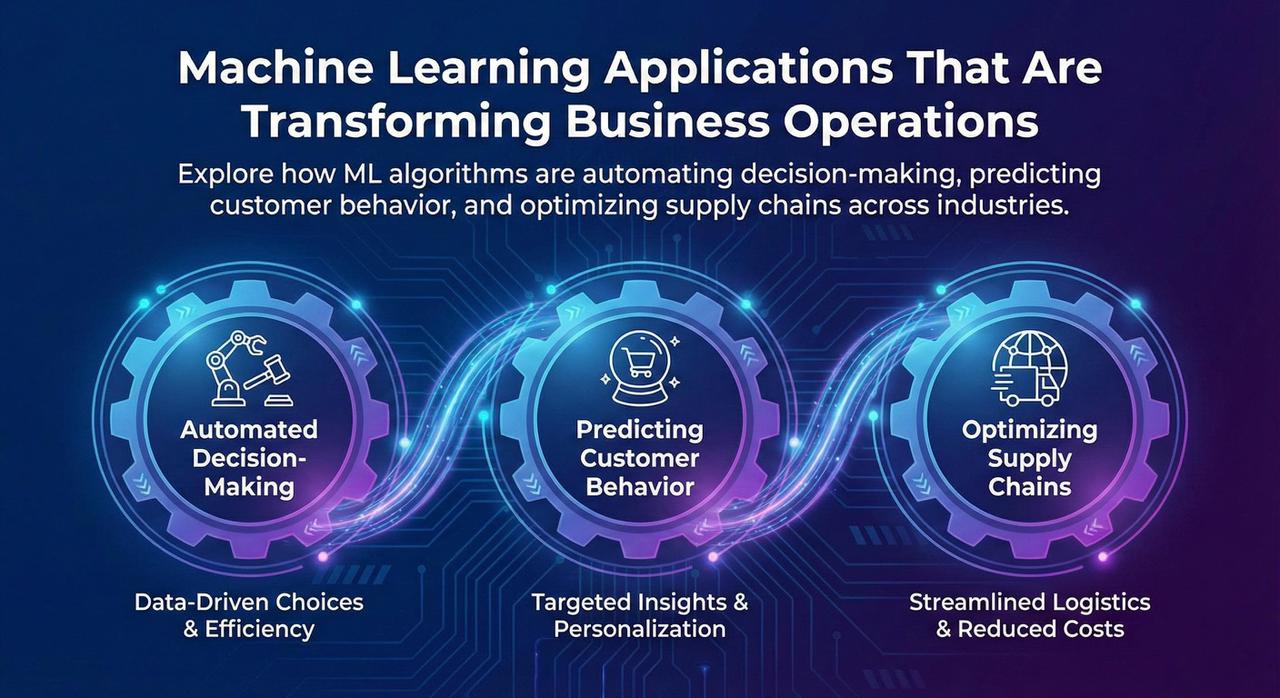
Machine Learning is revolutionizing how businesses operate, from automating routine decisions to predicting market trends with unprecedented accuracy. Organizations across industries are discovering that ML isn't just a competitive advantage—it's becoming essential for survival in today's data-driven economy.
Predictive Analytics in Business
Companies are leveraging ML algorithms to forecast sales, predict customer churn, and optimize inventory management. These predictive models analyze historical data patterns, market trends, and external factors to make accurate future predictions that drive strategic decision-making.
Modern predictive analytics goes beyond simple trend analysis. Advanced ML models can identify complex patterns in customer behavior, market dynamics, and operational data that would be impossible for humans to detect. For example, retail companies use ML to predict demand at the SKU level across thousands of stores, optimizing inventory levels and reducing waste by up to 40%.
Customer Behavior Analysis
ML-powered recommendation engines analyze user behavior to provide personalized product suggestions, increasing conversion rates by up to 35%. E-commerce giants like Amazon and Netflix have perfected this approach, but the technology is now accessible to businesses of all sizes.
These systems analyze browsing patterns, purchase history, demographic data, and even real-time behavior to create highly personalized experiences. They can predict what products a customer is likely to buy next, when they're most likely to make a purchase, and what price point will maximize both conversion and profit margin.
Business Impact
Organizations implementing ML-driven analytics report 25-30% improvement in operational efficiency, 20% reduction in costs, and up to 50% improvement in customer satisfaction scores. The ROI typically becomes positive within 6-12 months of implementation.
Supply Chain Optimization
ML algorithms optimize logistics, predict demand fluctuations, and identify potential supply chain disruptions before they occur, saving millions in operational costs. Companies using ML for supply chain management report 15-20% reduction in logistics costs and 30% improvement in delivery times.
Advanced ML models can analyze weather patterns, geopolitical events, supplier performance data, and market trends to predict potential disruptions weeks in advance. This allows companies to proactively adjust their supply chain strategies, source alternative suppliers, or adjust inventory levels before problems occur.
Fraud Detection and Risk Management
Financial institutions and e-commerce platforms use ML to detect fraudulent transactions in real-time. These systems analyze millions of transactions per second, identifying suspicious patterns and blocking fraudulent activities before they cause damage.
ML-based fraud detection systems continuously learn from new fraud patterns, adapting to evolving threats without requiring manual rule updates. They can detect sophisticated fraud schemes that traditional rule-based systems would miss, reducing fraud losses by 50-70% while minimizing false positives that frustrate legitimate customers.
Process Automation and Optimization
ML is transforming business process automation by enabling systems to handle complex, judgment-based tasks that previously required human intervention. From automated document processing to intelligent customer service routing, ML is making operations more efficient and cost-effective.
For example, ML-powered document processing systems can extract information from invoices, contracts, and forms with 95%+ accuracy, reducing processing time from hours to seconds. Customer service systems use ML to route inquiries to the most appropriate agent based on complexity, urgency, and agent expertise, improving resolution times by 40%.
Implementation Best Practices
Successfully implementing ML in business operations requires careful planning and execution. Here are key considerations:
- Start with clear business objectives - Define specific, measurable goals before selecting ML solutions
- Ensure data quality - ML models are only as good as the data they're trained on
- Build cross-functional teams - Combine domain expertise with data science skills
- Start small and scale - Begin with pilot projects to prove value before enterprise-wide rollout
- Monitor and iterate - Continuously evaluate model performance and refine as needed
Conclusion
Machine Learning is no longer a futuristic technology—it's a practical tool that businesses of all sizes can leverage to improve operations, reduce costs, and deliver better customer experiences. The key to success is starting with clear objectives, ensuring data quality, and taking an iterative approach to implementation.
As ML technology continues to evolve and become more accessible, the competitive advantage will belong to organizations that can effectively integrate these capabilities into their core business processes. The time to start is now.