


Python remains the undisputed king of AI and Machine Learning development. Its rich ecosystem of libraries, ease of use, and strong community support make it the go-to language for data scientists and ML engineers worldwide.
Why Python Dominates AI/ML
Python's dominance in the AI/ML space isn't accidental. The language offers a perfect balance of simplicity and power, making it accessible to beginners while providing the tools experts need for complex implementations.
Industry Statistics
According to the 2024 Stack Overflow Developer Survey, Python is used by 87% of data scientists and ML engineers. The language powers over 90% of machine learning projects in production environments worldwide.
Essential Python Libraries for AI/ML
The Python ecosystem offers powerful libraries that simplify complex AI/ML tasks:
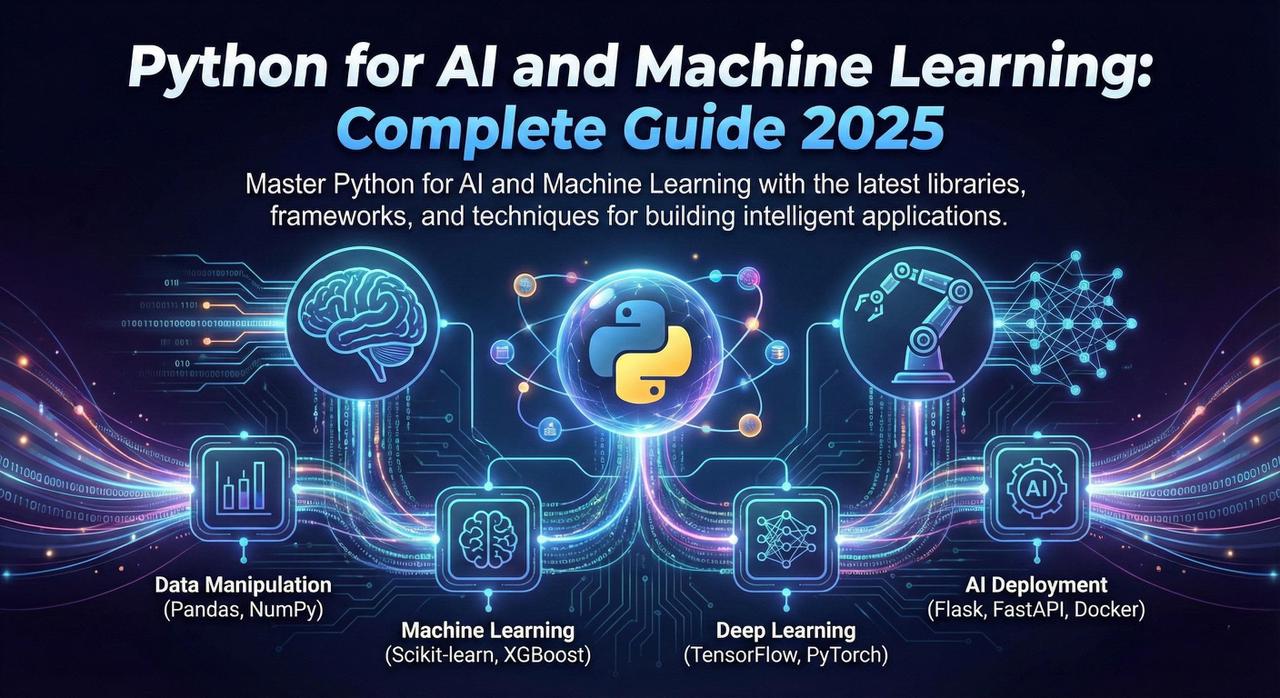
TensorFlow 2.x
Google's powerful deep learning framework with Keras integration. Perfect for production-ready ML models, neural networks, and large-scale distributed training.
PyTorch
Facebook's dynamic neural network library. Excellent for research, rapid prototyping, and intuitive debugging with eager execution mode.
Scikit-learn
The Swiss Army knife for classical ML algorithms. Includes classification, regression, clustering, dimensionality reduction, and preprocessing tools.
Pandas & NumPy
Essential for data manipulation and numerical computing. The foundation of any data science workflow with powerful array operations.
Building Your First ML Model
Let's walk through building a classification model with scikit-learn:
import pandas as pd
from sklearn.model_selection import train_test_split
from sklearn.preprocessing import StandardScaler
from sklearn.ensemble import RandomForestClassifier
from sklearn.metrics import accuracy_score, classification_report

# Load and prepare data
data = pd.read_csv('customer_data.csv')
X = data.drop('churn', axis=1)
y = data['churn']

# Split data
X_train, X_test, y_train, y_test = train_test_split(
    X, y, test_size=0.2, random_state=42
)

# Scale features
scaler = StandardScaler()
X_train_scaled = scaler.fit_transform(X_train)
X_test_scaled = scaler.transform(X_test)

# Train model
model = RandomForestClassifier(n_estimators=100, random_state=42)
model.fit(X_train_scaled, y_train)

# Evaluate
predictions = model.predict(X_test_scaled)
print(f"Accuracy: {accuracy_score(y_test, predictions):.2f}")
print(classification_report(y_test, predictions))
Deep Learning with TensorFlow
For more complex problems, deep learning provides powerful solutions:
import tensorflow as tf
from tensorflow.keras import layers, models

# Build a neural network
model = models.Sequential([
    layers.Dense(128, activation='relu', input_shape=(input_dim,)),
    layers.Dropout(0.3),
    layers.Dense(64, activation='relu'),
    layers.Dropout(0.3),
    layers.Dense(32, activation='relu'),
    layers.Dense(num_classes, activation='softmax')
])

# Compile model
model.compile(
    optimizer='adam',
    loss='sparse_categorical_crossentropy',
    metrics=['accuracy']
)

# Train with early stopping
early_stop = tf.keras.callbacks.EarlyStopping(
    monitor='val_loss', patience=5, restore_best_weights=True
)

history = model.fit(
    X_train, y_train,
    epochs=100,
    batch_size=32,
    validation_split=0.2,
    callbacks=[early_stop]
)
Latest Trends in Python AI/ML (2025)
-
1
Large Language Models (LLMs)
Using transformers and Hugging Face for NLP tasks. Fine-tuning pre-trained models like GPT, BERT, and LLaMA for domain-specific applications.
-
2
AutoML & Automated Feature Engineering
Libraries like Auto-sklearn, TPOT, and H2O AutoML automate model selection and hyperparameter tuning, making ML accessible to non-experts.
-
3
MLOps & Model Deployment
Streamlining ML workflows with MLflow, Kubeflow, and DVC. Implementing CI/CD for machine learning models with automated testing and monitoring.
-
4
Edge AI & TinyML
Deploying models on edge devices with TensorFlow Lite and ONNX Runtime. Running inference on IoT devices, mobile phones, and embedded systems.
Best Practices for Production ML
Data Quality
Invest in data quality. Clean, well-labeled data is more important than complex algorithms. Implement data validation pipelines.
Experiment Tracking
Use tools like MLflow or Weights & Biases to track experiments, compare models, and reproduce results.
Conclusion
Python's dominance in AI/ML is set to continue in 2025 and beyond. By mastering these libraries and staying updated with the latest trends, you can build powerful intelligent applications that solve real-world problems.
Whether you're building recommendation systems, computer vision applications, or natural language processing solutions, Python provides the tools and ecosystem you need to succeed. Start with the fundamentals, practice with real datasets, and gradually tackle more complex problems.
The future of AI is being written in Python, and there's never been a better time to join this exciting field.